
I've rearranged my crystal shelf more times than I care to admit. And after visiting dozens of collectors' homes, I keep seeing the same display errors. Sun-faded amethyst. Cluttered clusters on windowsills. Selenite that's basically dissolving into a puddle of regret. Displaying crystals isn't about buying an expensive shelf. It's about a few practical decisions most guides skip.
Quick Flick Through
1. Light Exposure: The Rule That Saves Fade-Prone Stones
Most articles tell you to keep crystals near a window for "good energy." I learned the hard way. My first piece of rose quartz lost its pink heart after two summers on a south-facing windowsill in a London flat. The color literally bleached out.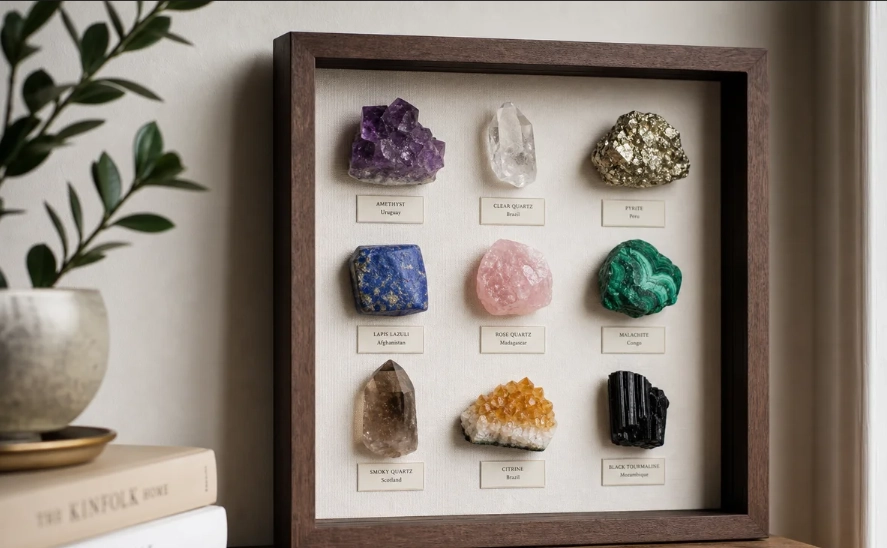
Here's the split that actually matters. Stones like amethyst, rose quartz, citrine, and fluorite are sensitive to direct UV. Others like clear quartz, smoky quartz, and black tourmaline hold up fine. I checked with the gemstone care guidance from the Gemological Institute of America (GIA), which notes that prolonged sunlight can alter color stability in certain gem materials.
The practical rule I use now
Place UV-sensitive crystals on shelves at least 2 meters back from a south or west window. Or use a sheer curtain. My 1-meter-wide east window gets soft morning light, and my amethyst cluster has lived there for three years with zero fading. That distance plus indirect glass made the difference.
2. Grouping Logic: Why Pairing by Size Fails
Walk into a beginner's home and you'll see all the big pieces on one shelf, all the small tumbles on another. It looks tidy in a photo. It feels wrong in person.
What works better: group by texture and color temperature. Rough clusters (like raw spirit quartz) next to smooth polish (like a large clear quartz sphere) creates a visual anchor. I learned this from a display designer at London's Natural History Museum shop, who told me to treat pebbles like rocks in a riverbed. Same principle.
My go-to formula
Every 30 cm of shelf gets one large piece (maximum 10 cm tall), two medium pieces (4–6 cm), and a scatter of three small tumbles. That breaks the "big blocks" look. A single cluster with one small companion stone feels intentional. A row of five identical pieces feels like a shop shelf.
3. Shelf Height and Eye Line: What Your Neck Knows
This one isn't about aesthetics. It's about actually seeing your crystals. If your display shelf sits above 160 cm from the floor (around eye level for an average adult), you're looking up. The underside of a geode isn't interesting.
I moved my main shelf from 170 cm to 135 cm. Immediately, I noticed the deep purple zones inside my amethyst cathedral that I'd never seen before. Display height around 120–140 cm from the floor puts most pieces in a relaxed, natural gaze. For wall-mounted shelves, check with a quick eye-level test: stand one step back. If you have to tilt your head, shift it down.
4. The Cleansing Nook: Where Not to Put Your Pieces
Lots of crystal folks cleanse under moonlight or with sage. Fine. But the placement during cleansing matters more than the ritual. I made the mistake of setting a full tray of crystals on a metal radiator cover after a smoke cleanse. The heat stress cracked my selenite plate.
Here's the non-obvious tip: keep your cleansing spot away from heat sources (radiators, direct lamp bulbs, kitchen hobs) and away from high-traffic footfall. A windowsill in a spare room works if it's away from sun. A corner on a low bookshelf works. I now use a dedicated small wooden tray on my bedroom floor for overnight cleansing. No cracks since.
5. Small-Space Display: A Real Example from a Studio Flat
My friend in Manchester lives in a 35-square-meter studio with no shelf space. Her trick: a two-tier floating spice rack mounted on the wall near her desk. The rack is 40 cm wide, has a lip to prevent sliding, and cost her £15 at a hardware store. She fits eight small tumbles and two palm stones across the tiers.
The key detail: she lined the shelves with a strip of black felt (cut from a craft sheet). Stones don't slide when she shuts the flat door a bit too hard. That's the kind of fix you only learn by living with a display. Nothing in the spice rack holds anything over 5 cm tall, which keeps it stable.
FAQ: Real Questions from Real Collectors
My quartz points keep tipping over on a glass shelf. How do I stop this without sticky tack residue?
Skip the putty. Cut a small square of clear museum wax (the kind galleries use for ceramics) and press the base of the point into it. No residue on glass and it holds firm. I've used the same tiny bit for two years on my display cabinet.
Should I put my crystals on a windowsill to charge them in the sun?
Only clear quartz and smoky quartz tolerate direct sun for long periods. Amethyst, rose quartz, and fluorite will fade even through glass. I charge mine on a tray inside a well-lit room but out of direct rays. The moonlight idea is fine, but sunlight is overrated for most colored stones.
What's the best way to display a large geode that weighs over 2 kilos?
Don't put it on a floating shelf. I learned this from a carpenter who fixed my first broken shelf. Use a solid wood shelf anchored into studs with 5 cm screws. Put the geode's heaviest side toward the wall. A rubberized shelf liner underneath stops creeping. For open-face geodes, tilt them back 15 degrees using a small foam wedge hidden behind.
Is it okay to mix crystals with houseplants on the same shelf?
Yes, but not on the same surface. Live plants need watering, and splash will leave hard water spots on polished stones. I use a two-level metal tier: plants on the top, crystals on the bottom. Also, some plants (like pothos) have fast root growth that can push against tumbles. Keep a 10 cm gap.
This piece was fact-checked against public care guidance from the GIA and my own in-person visits to collector displays across the UK. No affiliate links, just experience.

Leave a Comment