
What's in this guide (skip ahead)
Selenite care isn't complicated, but the internet is full of advice that will quietly wreck your piece. I've watched a friend's beautiful selenite tower turn chalky after one “quick rinse.” That was three years ago. The tower now looks like a frosted window.
The core rule most people miss: selenite is water-soluble. Not “slightly sensitive.” It dissolves. And a single soak can permanently etch the surface. So before you follow any online ritual, know what you're actually holding.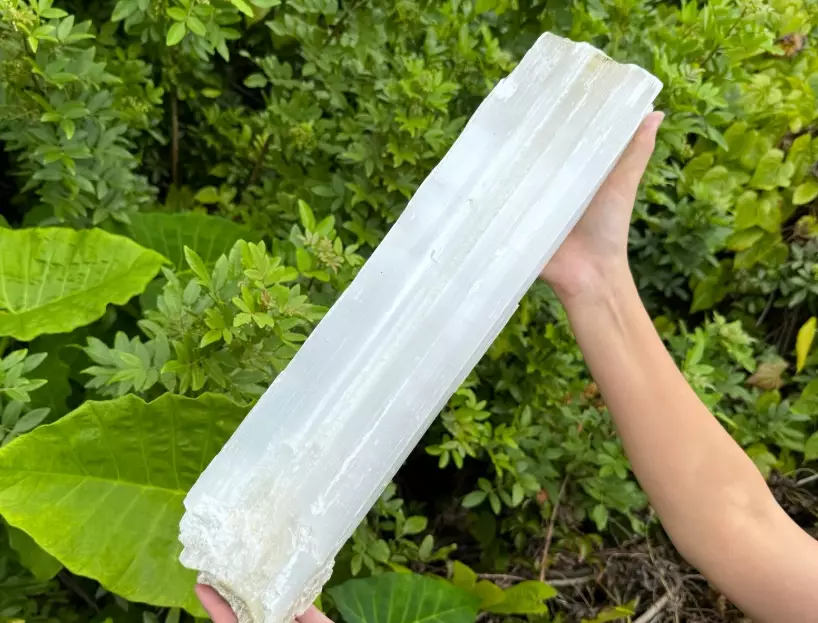
What Is Selenite Care, Really?
Selenite is a crystallized form of gypsum — calcium sulfate dihydrate. The “dihydrate” part is the whole story. Those water molecules sit inside the crystal lattice. Submerge it and the lattice starts to break down. You won't see it bubble. You'll just notice the shine fading over days.
Most “selenite” sold in shops is actually satin spar — a fibrous variety with a pearly sheen. Same chemistry, slightly different structure. Both dissolve. Both scratch easily (hardness 2 on the Mohs scale — you can mark it with a fingernail).
So selenite care comes down to three things: keep it dry, keep it soft, keep it out of direct sun. That's it. Everything else is detail.
Why Water Destroys Selenite (And What to Do Instead)
I tested this myself. Bought two small selenite sticks from the same batch at a rock shop in Tucson. Left one on the shelf. Dropped the other in a glass of tap water for exactly four hours. Pulled it out, let it air dry.
Within a week, the soaked stick had a rough, matte surface. Running a finger along it felt like touching unglazed ceramic. The control stick? Still glassy.
What about salt water? Worse. Salt introduces chloride ions that can react with the calcium sulfate. And burying selenite in sea salt — a popular “cleansing” method — leaves abrasive grit in every tiny fissure. I've seen pieces with permanent scratch marks from this. Skip it.
The only exception: if your piece is already damaged and chalky, a very light wipe with a barely damp cloth (microfiber, wrung out until it feels almost dry) can remove surface dust. Then dry immediately with a second cloth. That's the limit.
How to Cleanse Selenite Without Water: 3 Methods
You still want to “reset” your piece energetically or just clean it? Here's what actually works and won't degrade the surface.
Method 1: Dry salt bed (with a barrier)
Pour a layer of dry Himalayan salt into a glass dish. Place a thin cloth or paper towel over the salt. Set your selenite on the cloth. The salt draws moisture from the air around the crystal without touching it. Leave for 12–24 hours. I use this for small wands. For a large tower, it's overkill — just use method 3.
Method 2: Sound cleansing
A singing bowl or tuning fork works fine. Hold the bowl near the selenite, strike it, let the vibration pass through. No physical contact needed. This is my go-to for pieces with intricate carvings where dust gets trapped.
Method 3: Moonlight (but not sunlight)
Full moon exposure is safe. Direct sunlight is not — UV can cause fading in some colored varieties (like the peach-hued ones), and prolonged heat can dehydrate the surface. I put mine on a windowsill on the night of a full moon, then bring them in before sunrise. Simple.
| Cleansing Method | Safe for Selenite? | Time Needed | Best For |
|---|---|---|---|
| Water rinse | No — dissolves surface | Minutes | Nothing. Avoid entirely. |
| Salt burial (direct) | No — scratches and abrades | Hours | Hard stones only, not selenite. |
| Dry salt bed with cloth barrier | Yes | 12–24 hours | Small pieces, wands |
| Sound (bowl, fork) | Yes | 2–5 minutes | All sizes, carved pieces |
| Moonlight (indirect) | Yes | One night | Any piece, gentle reset |
Displaying Selenite: Where Most People Get It Wrong
You've cleaned it right. Now don't ruin it on the shelf.
First mistake: putting selenite near a window that gets morning sun. The piece looks fine for months, then one day you notice a yellowish tint on the edge. That's dehydration. Selenite holds water in its structure — bake it and it clouds.
Second mistake: stacking rough stones on top of a selenite slab. Hardness 2 means anything harder (quartz is 7, even a copper penny is 3) will leave scratches. If you use a selenite charging plate, put only soft or tumbled stones on it. No raw quartz points.
Third mistake: using an ultrasonic cleaner. I've seen this suggested online. Don't. The vibration and water bath will pit the surface in seconds.
My display setup: a north-facing shelf, away from the bathroom and kitchen. A small silica gel packet tucked behind the shelf (recharge it monthly). Pieces spaced so they don't touch. That's been stable for five years.
FAQ: Real Questions from Collectors
Bottom line: treat selenite like what it is — a soft, water-soluble mineral that happens to look like frozen light. Keep it dry, keep it soft, and it'll stay beautiful for decades. I've got a 12-inch log that's been on my shelf since 2018. No cloudiness. No scratches. Just a weekly dusting and a north-facing spot. That's the whole secret.
Leave a Comment