If you are just starting out, stick to a handful of common minerals for beginners and learn them cold before chasing rare specimens. I have walked beginners through dozens of creek beds and quarry piles, and the people who progress fastest are the ones who master seven or eight species first.
What is inside this field guide
Start with a simple mineral ID kit
You do not need a laboratory. A pocket knife, a copper penny, a steel nail, a streak plate, a hand lens, and a small bottle of vinegar cover most of what you will meet on your first trips. I keep mine in a small canvas pouch that lives in my backpack. The total cost is usually under twenty dollars at a local rock shop or online mineral supplier.
The vinegar is the one item people forget. A drop of weak acid is the fastest way to separate calcite from quartz, and that single test saves beginners hours of confusion.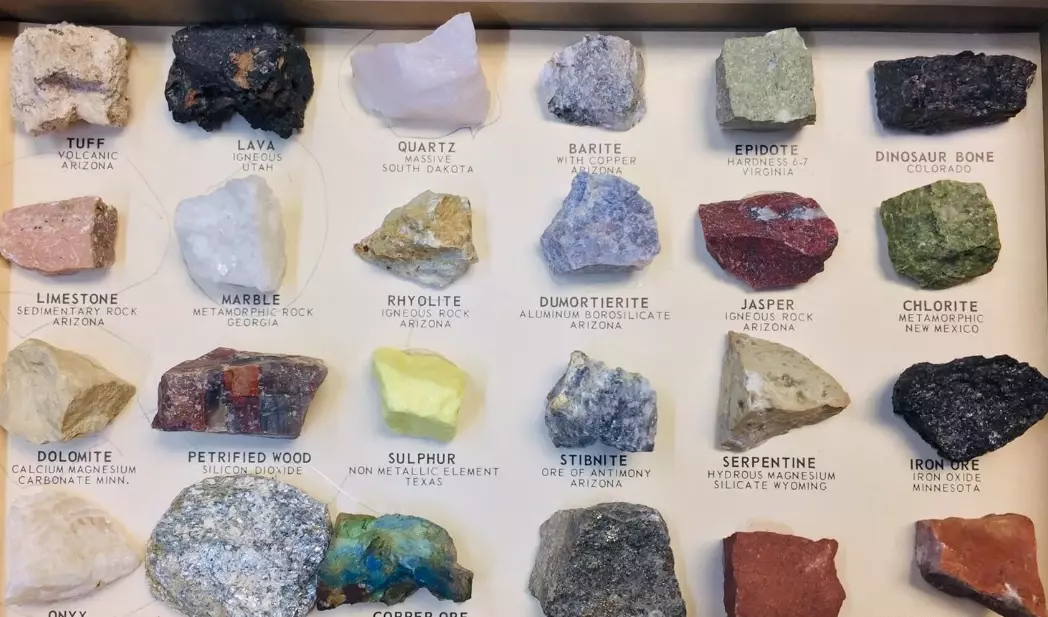
The seven common minerals to learn first
These seven show up in most beginner localities across North America and Europe. Once you can identify them on sight, your confidence grows fast.
| Mineral | Hardness | Streak | Best field clue |
|---|---|---|---|
| Quartz | 7 | White | Scratches glass, no cleavage |
| Calcite | 3 | White | Fizzes in vinegar |
| Feldspar (plagioclase) | 6 | White | Two flat cleavage planes |
| Mica (muscovite) | 2.5 | White | Peels into thin sheets |
| Pyrite | 6.5 | Greenish black | Brassy, cubic crystals |
| Magnetite | 6 | Black | Magnet sticks to it |
| Hematite | 5 to 6 | Reddish brown | Red streak, heavy feel |
Notice how many of these are defined by a single test. That is the point. Beginners who try to memorize twenty minerals end up remembering none of them.
How do you test a mineral in the field?
Work through a fixed order. First, look at color and luster. Second, check hardness by scratching a glass bottle or a penny. Third, streak the mineral on the plate. Fourth, test for acid reaction on a fresh surface.
Here is a short scenario. I once watched a new collector pick up a shiny yellow chunk and call it gold. The streak was greenish black, and the hardness scratched a copper penny. It was pyrite. The moment he saw the streak, the lesson stuck. That is why the streak plate matters more than any book.
For authoritative reference, the Mindat mineral database is the standard lookup for species descriptions and locality data. The U.S. Geological Survey publishes plain-language guides on mineral resources that are useful background reading.
Avoid these beginner mistakes
Most guides tell you what to do. Few tell you what quietly goes wrong.
- Testing on a weathered surface. Oxidation masks streak and acid reaction. Break a small corner to get a fresh face.
- Trusting color alone. Quartz comes in every color of the rainbow. Color deceives, streak rarely does.
- Skipping the magnet. Beginners miss magnetite because they assume heavy black rocks are just basalt.
- Confusing cleavage with fracture. Flat shiny planes mean cleavage. Curved glassy breaks mean fracture.
Where should you look for beginner minerals?
Beaches, creek gravel bars, road cuts, and old quarry dumps are the four easiest starting grounds. Creek gravel is my favorite because moving water concentrates heavy minerals like magnetite and hematite into dark streaks along the inner bends.
Road cuts expose fresh rock, which is ideal for feldspar and mica. Look for shiny flat faces catching the sun. If the rock peels in thin sheets, you are likely looking at muscovite.
Local gem and mineral clubs often run field trips to sites that are otherwise closed to the public. That access alone is worth the membership fee, and experienced members will correct your identification on the spot.
How can I tell quartz from calcite if both look white and glassy?
The acid test is the fastest tiebreaker. Put a drop of vinegar on a fresh broken surface. Calcite bubbles gently, quartz does nothing. Hardness confirms it: quartz scratches glass, calcite does not.
My pyrite keeps turning dull and rusty after a few weeks. Did I ruin it?
That is normal oxidation. Pyrite reacts with humid air, especially in coastal climates. Keep specimens in a sealed container with a small silica packet. Do not wash them with water and store them wet, which speeds up decay.
How do I know whether a shiny flat surface is cleavage or fracture?
Look for repeated parallel planes. If you can see several flat surfaces at consistent angles, that is cleavage. If the break is curved and glassy with no repeat pattern, it is fracture. Feldspar shows cleavage; quartz shows fracture.
Is a smartphone app good enough for mineral identification?
Treat apps as a hint, not a verdict. They read color and texture and often miss streak and hardness. I have seen apps label magnetite as slag more than once. Buy a ten-dollar streak plate and a magnet; that combination beats most apps.
This guide was fact-checked against standard mineral identification references including Mindat species data and USGS mineral information resources.
Leave a Comment